Why Your YouTube Shorts Get No Views (It's Usually Not Your Content)
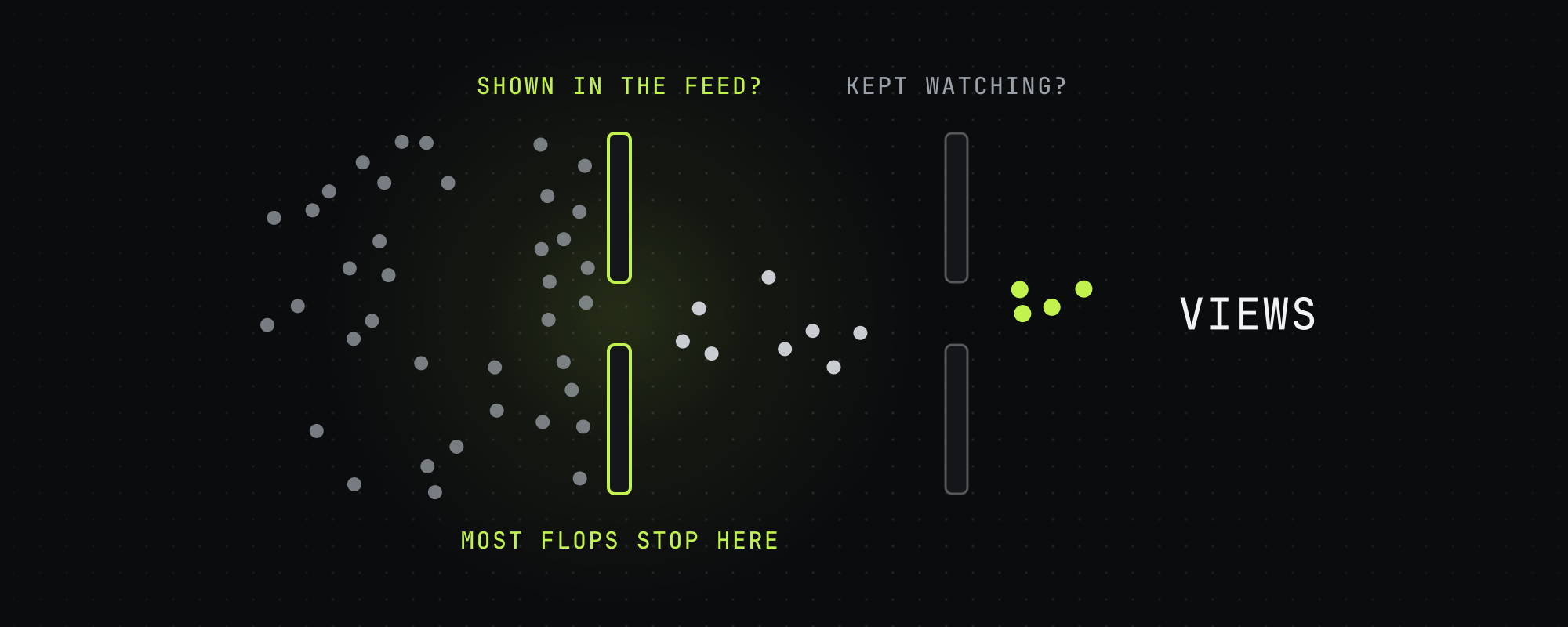
A Short's view count is two filters multiplied together: whether YouTube admits it to the feed, and whether viewers keep watching. On our data, most 'flops' never failed the audience test — they failed the admission test. Videos under 50 views averaged 59.5% retention, some over 100%. Fix distribution first (topic, length, title), then worry about the edit.
We published 84 Shorts on one channel over five months, then did something most creators never do: joined every video's lifetime view count against its retention data from the YouTube Analytics API. The result contradicted almost every piece of 'why your Shorts flop' advice we'd read. Our worst-performing videos — the ones stuck under 50 views — had better retention than our mid-tier ones. People who saw them watched to the end. Some watched twice.
That one join changes the whole diagnosis. If viewers loved the flops, the flops didn't fail with viewers. They failed somewhere earlier — before any meaningful audience saw them at all. This article walks through what the data showed, how to run the same test on your own channel in about ten minutes, and what actually moved views for us once we fixed the right filter.
Shorts with great retention can still get zero views
Here's the finding that started it. Of our 84 Shorts, 24 landed under 50 lifetime views. Those 24 averaged 59.5% average view percentage — meaning the typical viewer watched well past half the clip. Several averaged over 100%, which means the average viewer watched the whole thing and looped it. One clip sitting at 2 total views had 103% retention.
Compare the winners: our 600+-view videos averaged 73% retention. Better, sure. But not 'distributed 400x harder' better. The audience wasn't the variable. Distribution was.

A Short's views are the product of two separate filters: views ≈ (YouTube admits it to the feed) × (viewers keep watching it). Retention data tells you which filter killed a video. Almost all advice online only addresses the second filter.
This is invisible if you only look at view counts, because the dashboard reports views as a single number. A creator who watches views alone will conclude 'this content is bad' when the truth is 'this content was never shown to anyone.' Those are different problems with opposite fixes.
How the YouTube Shorts algorithm decides what gets distributed
YouTube tests each new Short with a small batch of impressions and expands distribution if early swipe-away and completion numbers look good. That part is widely known. What the retention join reveals is a step before the impression test: an admissibility check. Some videos never get the test batch at all — they land at 0–15 views no matter how strong the content is, and their (excellent) retention numbers prove the few people who saw them had no complaints.
The gate leaves a fingerprint you can spot on any channel: a bimodal view distribution. Our videos either reached 600–1,800 views or died under 50, with almost nothing in between — 8 of 21 uploads in one two-week stretch got fewer than 15 views while their siblings from the same source videos cleared 800. If your channel's view histogram has a hole in the middle, you're not inconsistent. You're being gated on some axis, and the low mode tells you which videos to inspect.
The topics YouTube quietly suppresses
When we sorted our sub-50-view videos by topic, the pattern was blunt. Nearly every one fell into three lanes:
- Intelligence-agency and conspiracy content — clips mentioning the CIA, Epstein, surveillance, torture programs, 'mysterious deaths.' Six of our eight worst recent flops were in this lane.
- Drugs and graphic health shock — fentanyl, opioids, overdose stories, microplastics-in-the-body content, alarming cancer statistics.
- Gender culture-war bait — 'is feminism X' framing, witchcraft angles, woke-bashing.
None of these triggered a strike, a warning, or any notice in YouTube Studio. The videos published normally and then simply never entered the feed. That silence is the point: topic-level suppression is undetectable unless you cross-reference retention, because everything looks like ordinary underperformance.
The cost compounds quietly, too. Before we caught this, roughly 40% of a month's uploads were burned on gated topics — slots that could have carried admissible clips. The fix wasn't editing harder. It was refusing to clip those lanes at all, no matter how compelling the moment. A gripping moment and a distributable moment are independent properties, and the second one multiplies everything else.
A suppressed topic re-edited with a better hook is still suppressed. If a video is gated, no amount of editing, captioning, or title work will move it. Change the topic or drop the clip.
How to tell if your Shorts are gated: the views × retention test
You can run our exact diagnosis on any channel in about ten minutes. Open YouTube Studio → Analytics → Content, pull average view percentage per Short (or query the YouTube Analytics API for `averageViewPercentage` if you want it in a spreadsheet), and place each video in this grid:
| High retention (55%+) | Low retention (under 45%) | |
|---|---|---|
| Low views | Topic was gated — never distributed. Fix the topic, not the edit. | Failed its impression batch. Weak first 3 seconds. |
| High views | Winner. Mine the same source and topic for more clips. | Earned distribution, then leaked viewers — clip too long or the hook overpromised. |
Every Short sorts into one quadrant, and each quadrant has a different fix. Without retention data, the two left-column failures look identical.
The reason this grid earns its place: the failure modes need opposite responses. Low views + high retention means your content is fine and your topic is the problem. High views + low retention means your topic is fine and your clip is the problem — usually too long, or a hook that wrote a check the payoff didn't cash. Creators who can't see the difference fix the wrong one, conclude nothing works, and quit.
The best length for a YouTube Short, by the numbers
Length was the second-strongest pattern in our data, and it was monotonic — every step up in duration cost views:

| Length | Videos | Avg views | Median views | Flop rate |
|---|---|---|---|---|
| Under 20s | 8 | 1,298 | 1,597 | 0% |
| 21–35s | 26 | 750 | 759 | 23% |
| 36–50s | 28 | 605 | 622 | 36% |
| 51s+ | 21 | 445 | 156 | 38% |
84 published Shorts, one channel, March–July 2026.
The retention data explains why the effect is this strong: short clips loop. Our top performers all show average view percentage above 100% — one 5-second clip hit 152%, meaning the typical viewer watched it more than one and a half times. A clip that ends before the viewer's swipe reflex fires gets looped almost by accident, and loops read to the algorithm as elite engagement. A 45-second clip physically cannot access that multiplier.
So the practical rule: cut to the payoff and stop. If the moment is 20 seconds, publish 20 seconds — padding it to 45 trades a loop rate above 100% for a completion cliff. (Platform-by-platform length benchmarks are in our best clip length guide.)
How to title a YouTube Short: plain claims beat clickbait
We ran two title styles across the same channel without initially realizing it, which gave us an accidental A/B test. The cohort titled like classic clickbait — 'The Shocking Truth About X! 😱', emoji, exclamation marks — averaged under 100 views. The cohort titled as a flat declarative claim — 'Bragging Kills Attraction, Here's Why', 'Rent control is a failed policy, here's why' — produced the channel's 1,500–1,800 view performers.
Our read: shock-styling now pattern-matches to spam for both viewers and, plausibly, the same classifier that runs the admissibility gate. The title rules we now enforce on every upload:
- State the claim plainly, optionally with ', here's why' — let the curiosity gap do the work.
- No emoji, no exclamation marks, no hashtags in the title, no ALL-CAPS words.
- Never 'shocking', 'insane', 'you won't believe', or a question-mark title.
A checklist for high-converting YouTube Shorts
Putting the whole system in order — note that the audience-facing craft only starts at step 3, because the first two steps decide whether an audience ever sees it:
- Check topic admissibility first. If the clip touches a lane your channel's data shows getting gated (or the obvious suspects above), skip it — a weaker moment in an admissible lane will outperform it.
- Pick a moment that passes the share test — someone would DM it to a specific person. Our guide to finding viral moments covers the moment types that travel.
- Cut it to 15–35 seconds, shorter if the payoff allows. Sub-20-second clips loop, and loops compound.
- Put the hook in the first 3 seconds — the boldest claim or most surprising line, never the setup. Proven openers are in our hook frameworks.
- Title it as a plain declarative claim. No emoji, no shock-words.
- Diagnose with the views × retention grid monthly, and re-derive your rules from it — the gate's topic list moves, and last quarter's rule is next quarter's stale assumption.
One honest caveat: this is one channel's 84 videos, not a platform-wide study. But that's also the argument for the method over the specific numbers — ten minutes with your own retention data beats any generic advice list, ours included. If you'd rather have the topic filter, length bias, and title rules enforced automatically at clip time, that's what Highstyle does to every clip it generates.
Frequently asked questions
Why are my YouTube Shorts stuck at 0 views?
Check the video's average view percentage in YouTube Studio before assuming the content failed. If retention is strong (55%+) on the few views it got, the video was likely never distributed — usually a topic-level gate — and no edit will fix it. If retention is weak, the video failed its impression test and the first 3 seconds are the problem.
Does YouTube shadowban certain Shorts topics?
YouTube doesn't use the word, and you get no strike or notice. But measured behavior matches the description: on our channel, clips touching intelligence-agency conspiracy themes, drugs and graphic health shock, and gender culture-war bait consistently landed under 50 views with excellent retention — they published normally and never entered the feed.
What is a good average view percentage for a YouTube Short?
Our 600+-view winners averaged 73%, and the best performers exceeded 100% — meaning viewers looped the clip. Under 45% usually means the clip is too long or the hook overpromised. Note that high retention alone doesn't guarantee views: our suppressed videos averaged 59.5% and still died, because retention only matters after distribution.
How long should a YouTube Short be?
On our data, shorter won at every step: Shorts under 20 seconds averaged 1,298 views with zero flops, while 51+ second Shorts averaged 445 with a median of 156. Sub-20-second clips also loop (average view percentage above 100%), which the algorithm rewards. Cut to the payoff and end — don't pad to fill time.
Does posting time matter for YouTube Shorts?
Far less than topic and length. Across 84 Shorts posted at various hours, we found no meaningful independent effect from posting time once topic was accounted for. Shorts surface via the feed for days after upload, so a gated topic at the 'perfect' hour still gets nothing.
Keep reading
Best Clip Length for TikTok, Reels, and Shorts in 2026
The algorithm-optimized clip lengths for TikTok, Instagram Reels, and YouTube Shorts in 2026 — and why completion rate, not duration, is what you're really optimizing.
How to Find Viral Moments in Long Videos and Podcasts
How to identify the moments in a long video worth clipping: the share test, the content types that travel, and why moment selection beats editing for going viral.
10 Short-Form Video Hook Frameworks That Actually Work in 2026
The 10 hook frameworks that drive the highest 3-second hold rates on TikTok, Reels, and Shorts in 2026, with examples and the pacing rules behind them.
What Percentage of Short-Form Clips Actually Go Viral?
Alex Hormozi says roughly one in ten shorts becomes a 2-3x outlier. We checked that against 189 clips and 172,192 views from our own network. The real shape of the distribution is different, and more useful.