How to Find Viral Moments in Long Videos and Podcasts
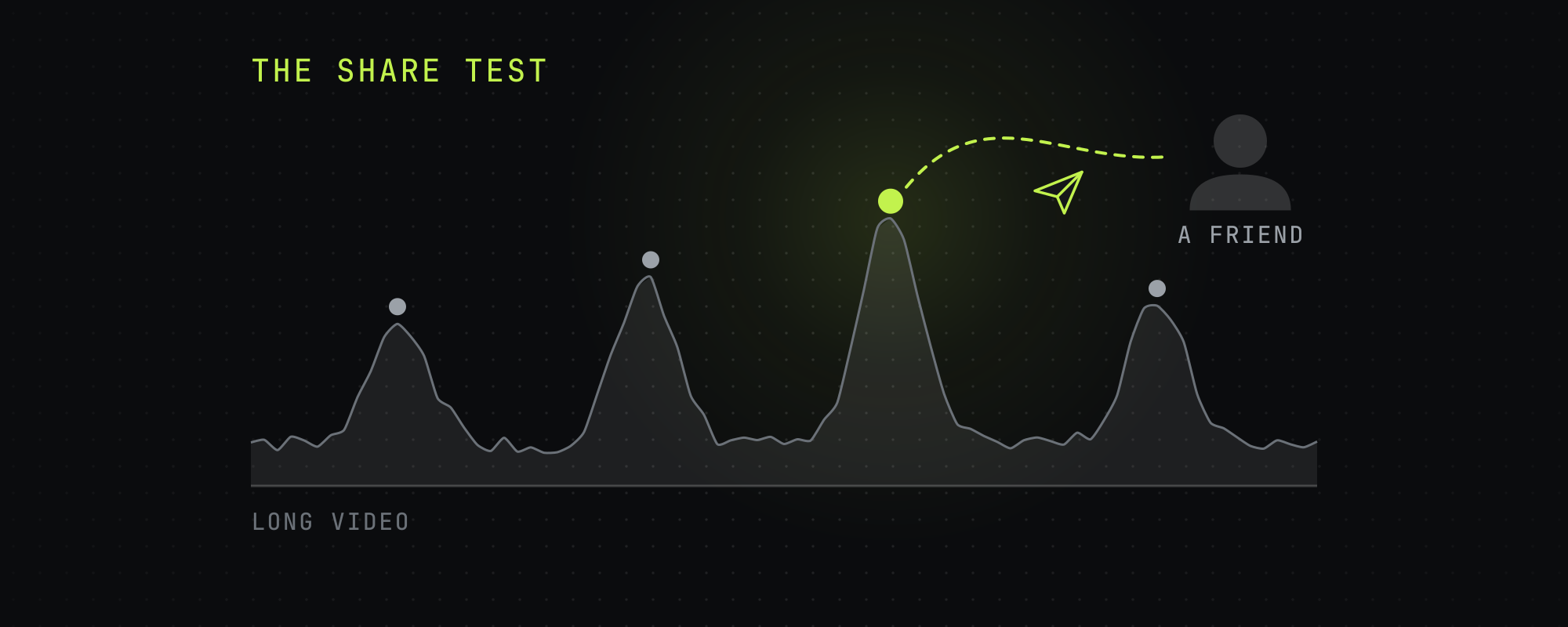
Finding the right moment matters more than how you edit it. The test that works is the share test: would someone send this clip to a specific friend? The moments that pass are usually controversial takes, vulnerable confessions, surprising facts, curiosity-gap questions, and standalone 'aha' insights — and they must work without the surrounding context.
AI tools have made the editing — cutting, captioning, reframing — nearly free. That means the edge has moved upstream, to selection: which 30 seconds of a two-hour podcast you choose to clip. A perfectly edited clip of a forgettable moment goes nowhere. A roughly edited clip of a genuinely share-worthy moment can hit millions. Selection is the highest-leverage decision in the whole process.
The share test
The single most useful filter: would someone DM this clip to a specific person? Not 'would someone watch it' — passive watching is cheap. Shares are the behavior the algorithms weight most heavily (shares are weighted far above likes on TikTok, and DM sends carry several times the weight of likes on Instagram). A clip that gets sent to friends beats a clip that gets passive likes every time. If you can't picture who would send a moment to whom and why, it probably isn't the moment.
For every candidate moment, name the share: who sends this, to whom, and what they'd say. 'My friend who's always broke needs to hear this.' If you can't write that sentence, keep looking.
The content types that travel
Across millions of clips, the moments that reliably generate shares fall into a handful of buckets, in roughly descending order of share power:
- Controversy and hot takes — challenging a widely held belief. These generate comments (a strong algorithm signal) and 'you need to hear this' shares. A single contrarian clip can hit eight figures of views.
- Vulnerability and confessions — 'I've never told anyone this' moments, personal stories, emotional revelations. People share because they relate or want someone else to understand something.
- Surprising facts and statistics — especially when they contradict common behavior. The gap between what people believe and what's true creates urgency to share.
- Curiosity-gap questions — a moment that opens with a question that demands an answer ('How did you go from homeless to $100M?') invests the viewer immediately.
- Comedy and tension — funny moments, disagreements with real friction, unexpected reactions. The most memeable beats spread fastest.
- Concrete, actionable advice — a specific tip the viewer can use right now. Saved and shared as a reference.
It has to stand alone
The most common selection mistake is clipping a moment that's only great if you heard the previous ten minutes. The clip is shown to someone who has never seen the podcast and will never see the rest. If the moment needs heavy setup to make sense, it's not a clip — or it needs a hook card and a sentence of context baked into the front. Test every candidate by asking whether a stranger would understand and care within the first three seconds.
Niche beats breadth
Moments that serve a narrow, specific audience outperform broadly 'interesting' ones. 'Fitness advice' is weak; 'why lifting advice fails people over 40' is strong. A specific persona means a specific share ('this is literally you'). When scanning a long video, prefer moments that speak pointedly to one kind of person over moments that are mildly relevant to everyone. This also compounds: a channel that consistently serves one niche trains the algorithm and the audience to expect it.
Know your channel's lanes. Some topics consistently underperform for a given account no matter how strong the moment. Track which niches actually convert to views and weight selection toward them.
How AI moment-detection works (and where it falls short)
AI clipping tools transcribe the video and use a language model to score segments for 'virality', surfacing candidate clips ranked by predicted performance. This is genuinely useful for batch-generating 10-30 candidates from a long video in minutes. But the models are good at finding 'interesting' segments and weaker at the human judgment of what will actually drive comments and shares in a specific niche. The strongest workflow is AI-first plus human curation: let the tool generate candidates, then discard most and hand-pick the few that pass the share test.
A selection workflow
- Generate or scan for 10-30 candidate moments across the full video.
- Apply the share test to each — name who sends it and why. Cut anything that fails.
- Drop anything that needs heavy context to make sense in the first 3 seconds.
- Weight what's left toward your channel's proven niches.
- Keep the top 3-10, and for each confirm the clip can open on the peak — not the build-up.
Once you've selected the moments, the edit is about execution: see how to edit podcast clips and how to caption short-form videos.
Frequently asked questions
What makes a moment go viral?
It passes the share test — someone would send it to a specific person. The moments that travel are controversial takes, vulnerable confessions, surprising facts, curiosity-gap questions, comedic or tense beats, and concrete advice. Passive 'interesting' moments that no one shares don't spread.
How many clips should I pull from one podcast?
Generate or scan 10-30 candidate moments, then ruthlessly cut down to the 3-10 that genuinely pass the share test. Volume at the candidate stage is good; volume at the publish stage dilutes quality. Most candidates should be discarded.
Can AI find viral moments automatically?
Partly. AI clipping tools transcribe and score segments for predicted virality, which is great for batch-generating candidates fast. But they're better at finding 'interesting' segments than judging what will actually drive shares in a specific niche, so the best results come from AI-first generation plus human curation.
Why do my clips get views but no shares?
Usually because the moment is interesting to watch but doesn't give anyone a reason to send it. Aim for moments that take a side, reveal something personal, or contradict a common belief — and that speak pointedly to a specific person rather than being mildly relevant to everyone.
Does the clip need context from the rest of the episode?
No — it has to stand alone. The clip is shown to people who never saw the episode. If a moment only lands with prior setup, either skip it or bake one sentence of context plus a hook card into the front so a stranger understands it within three seconds.
Keep reading
10 Short-Form Video Hook Frameworks That Actually Work in 2026
The 10 hook frameworks that drive the highest 3-second hold rates on TikTok, Reels, and Shorts in 2026, with examples and the pacing rules behind them.
How to Edit Podcast Clips That Hold Attention (Jump Cuts, Pacing, Filler)
How to turn long podcast footage into tight vertical clips: jump cuts, filler removal, silence trimming, pacing, reframing, and motion that holds retention.
How to Caption Short-Form Videos for TikTok, Reels, and Shorts (2026)
A practical guide to captioning short-form videos: font, size, placement, word grouping, color emphasis, and the sync rules that lift retention in 2026.
Content Is a Business Function, Not a Marketing Channel
A typical seven-figure business publishes 365 pieces of content a year. Alex Hormozi's portfolio publishes 35,000. The gap is staffing, not talent, and it changes how content should be run.