How Many Ad Creatives Should You Actually Test?
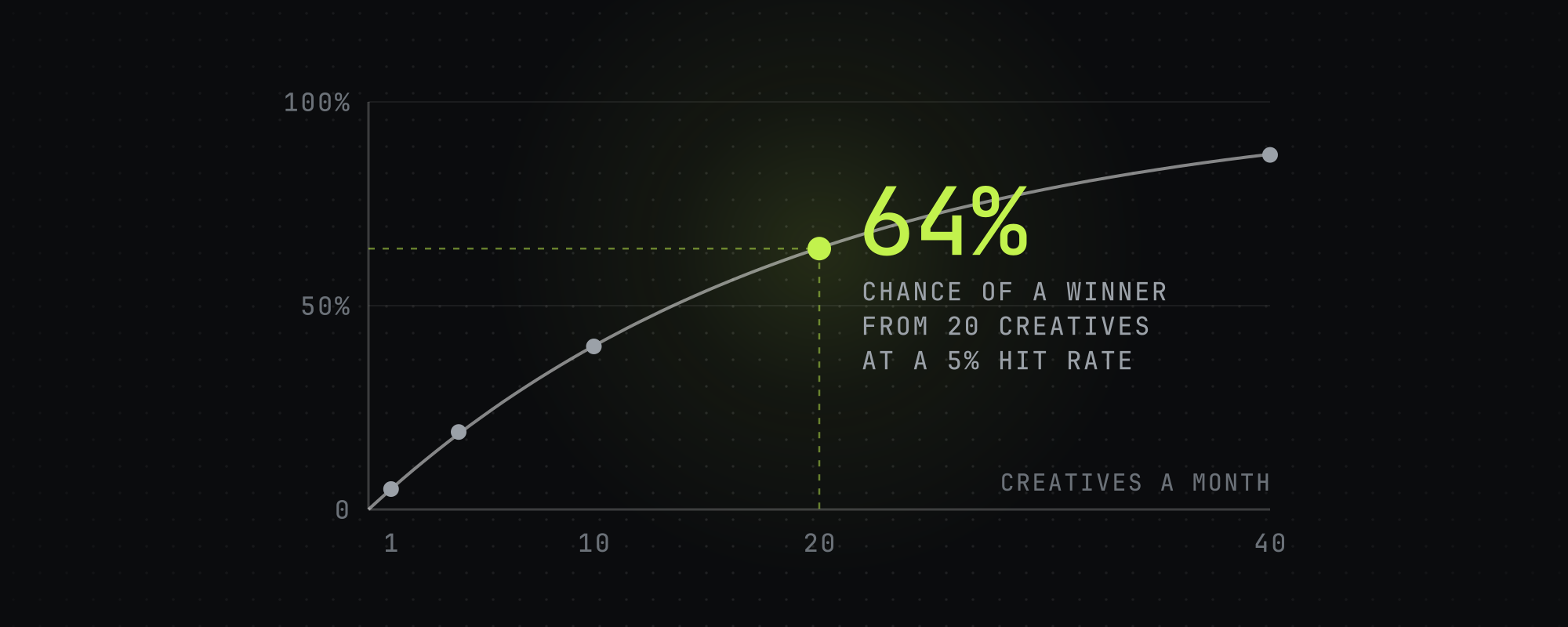
If roughly 5% of creatives win, one ad a month gives you a 5% chance of having a winner that month. You need somewhere around 15 to 25 attempts to expect one, which is why creative volume behaves less like a nice-to-have and more like the entry fee. The brands that compound are simply taking more shots than you are.
Most brands treat an ad as a project. You brief it, you shoot it, you approve it, you run it, and if it works you run it until it stops. That model came from television, where airtime was the expensive part and the tape was cheap by comparison.
On paid social the economics inverted and the workflow didn't follow. Distribution is auctioned by the impression and available to anyone with a card, so the scarce input became the creative itself, and specifically the number of distinct angles you can get in front of the algorithm before your budget runs out.
The number that reframes everything
Depending on account spend tier, somewhere between 4% and 8% of ads on Meta become winners. Everything else is either flat or quietly losing money until someone turns it off.
Sit with that for a second, because it changes what a creative brief is for. If about one in twenty attempts works, then a single ad is a lottery ticket you spent three weeks and several thousand dollars printing.
| Creatives shipped per month | Chance of at least one winner | Expected winners |
|---|---|---|
| 1 | 5% | 0.05 |
| 4 | 19% | 0.2 |
| 10 | 40% | 0.5 |
| 20 | 64% | 1.0 |
| 40 | 87% | 2.0 |
Assuming a 5% winner rate and independent attempts. Real campaigns aren't perfectly independent, which cuts both ways: a shared bad offer drags every variant down, and a strong angle lifts several at once.
At a 5% hit rate you need roughly 20 attempts to expect one winner. A brand shipping one hero video a quarter is running a four-year plan to find its first.
This is the part that trips up teams with genuinely good creative instincts. Being better at briefs might move your hit rate from 5% to 8%, which is a real improvement and still leaves you needing twelve or thirteen attempts. Skill raises the rate; volume is what converts a rate into an outcome.
What everyone else is shipping
Reported benchmarks put the median advertiser at six to seven creatives a week, and the top spend tier at twelve to nineteen or more. Some teams maintain forty-plus variants per campaign.
If your team is producing one or two a month, the gap isn't a matter of degree. You're playing a different game from the accounts you're bidding against, in the same auction, for the same impressions.
These figures come from ad-tech vendors and agencies who sell creative testing tools, so read them as directional. The winner rate is the number that matters most here, and it's the one that changes the conclusion least: at 4%, 8%, or 15%, the answer to "how many" is still very much more than one.
Then fatigue takes the winner away
Finding a winner isn't the end of the problem, because winners decay. The reported pattern is a drop in click-through of 20-40% from peak within about a week of active delivery, and Meta's own research has shown a 45% CTR drop after four repetitions against the same person.
Frequency is the usual early-warning signal, with practitioners briefing replacements around 2.5 and shipping by 3.5 on prospecting. The practical consequence is that a winner buys you weeks rather than quarters, so you need the next variation queued before the current one fatigues, permanently.
Meta's Andromeda ranking work pushed delivery further toward creative diversity and away from audience targeting, which raises the value of having many things to serve. The old lever, finding an underpriced audience, has mostly been automated away from you. The remaining lever is giving the system more to choose between.
Why the volume never arrives
Almost nobody disagrees with any of the above. The reason brands still ship one video a month is that the production model makes twenty impossible.
Booking a creator through a marketplace runs roughly $99 to $200 a video on the cheaper platforms, and $150 to $500 for TikTok-style work, plus one to three weeks of turnaround and a unit of product shipped to a stranger. Twenty of those is a five-figure line item and a logistics job, so what actually happens is that a marketer books two, picks the better one, and runs it until frequency climbs.
You also can't A/B test a person. A creator delivers their interpretation of the brief, and if the hook lands wrong you don't get a revision of that hook, you get a different creator, another shipment, and another three weeks. The feedback loop is longer than the fatigue window it's supposed to be feeding.
What actually changes the arithmetic
There are only three ways out, and it's worth being clear-eyed about what each one costs.
- Cut one shoot into many ads. The cheapest option and the most limited: you get variation in hook, caption, edit and length from footage you already own, though the visual premise stays fixed, and the premise is often the thing that's wrong.
- Seed to many creators at once. This is the TikTok Shop playbook, where a brand tags fifty to two hundred affiliate creators and lets them run a distributed test; one agency reported 110 affiliate videos for a single brand in a month. It works, and it costs commission and control over what gets said about your product.
- Generate the variations. The cost of the tenth version drops close to the cost of the first, which is the constraint that was actually binding. What you give up is that a generated presenter can demonstrate your product but cannot legally testify to using it.
Generating them is what we built Highstyle's product ads for, and the third option's catch is a hard legal line rather than a stylistic preference. The FTC's rule on consumer reviews and testimonials, 16 CFR Part 465, took effect in October 2024 and covers AI-generated reviews and reviews from anyone with no actual experience with the product, with civil penalties up to $53,088 per violation. A synthetic creator saying "I've been using this for a month and my skin cleared up" is a fabricated testimonial, and labelling the video as AI addresses a platform requirement without touching that one.
The workable script is demonstration. A generated presenter can show the product, explain what it does, and state claims you've supplied and can substantiate. First-person purchase and result claims are where the exposure lives.
A testing plan that survives contact
- Set a monthly creative target as a number, and treat missing it as a miss. Ten is a reasonable floor for a brand spending seriously; one is not a target.
- Vary the premise, not just the trim. Ten edits of one shoot test ten hooks against one visual idea, and the visual idea is a variable too.
- Write down the angle each creative is testing before it runs, so a loss teaches you something instead of just costing money.
- Watch frequency as your queue alarm. Brief the replacement at 2.5, ship it by 3.5, and never let the winner be the only thing running.
- Kill fast and unsentimentally. If 95% of attempts lose, most of your creatives deserve a small budget and a short life.
- Keep one polished asset for the surfaces that reward it. Your product page, retail, and connected TV are not the feed.
The shape of the change
The unit of creative strategy is moving from the video to the angle. Once the tenth version costs roughly what the first did, there's no longer a reason to bet a quarter's budget on one idea, and the teams that reorganise around that will find winners the teams commissioning one hero video never see.
Craft still matters, and this is really an argument about where to spend it: on generating and reading twenty attempts, instead of on perfecting one.
Frequently asked questions
How many ad creatives should I test per month?
If about 5% of creatives win, roughly 20 attempts is what it takes to expect one winner, so ten a month is a sensible floor for a brand spending seriously and more is better. Reported benchmarks put the median advertiser at six to seven a week, which is a useful reality check on what you're bidding against.
What percentage of Meta ads actually work?
Reported figures put it at 4-8% depending on account spend tier. The exact number matters less than the order of magnitude, because at any value in that range a single creative is a low-probability bet rather than a plan.
How quickly does ad creative fatigue?
Click-through commonly falls 20-40% from peak within about a week of active delivery, and Meta research has shown a 45% drop after four exposures to the same person. Frequency is the practical alarm: brief a replacement around 2.5 and ship it by 3.5 on prospecting.
Is it better to test many variations of one video, or many different videos?
Both, in that order of cost. Recutting one shoot is cheap and tests hooks against a fixed visual premise, and the premise itself is frequently the thing that's failing, so a testing plan that only ever varies captions and trims will plateau.
Can I use AI-generated creators to hit these volumes?
Yes, with one constraint that isn't negotiable. 16 CFR Part 465 bans fabricated testimonials including AI-generated ones, so a synthetic presenter can demonstrate your product and state claims you've substantiated, and cannot claim to be a satisfied customer. Platform AI labels satisfy Meta and TikTok, and they don't address the FTC rule.
Sources
Every figure above traces to one of these. Where a source sells the thing it measured, we say so.
- 01Ad Creative Testing Statistics for 2026 · AdLiftr, 2026Vendor-published; sells creative testing tooling, and no methodology is disclosed for the winner-rate figure.
- 02Creative Fatigue in Meta Ads: Detection Thresholds and Fix Playbook · Adsights, 2026Agency-published fatigue thresholds; directional rather than measured across accounts.
- 03TikTok Shop Case Study: How Your Ecommerce Store Can Grow · Top Growth Marketing, 2026Source of the 110-videos-in-a-month affiliate seeding figure; the agency sells this service.
- 04Federal Trade Commission Announces Final Rule Banning Fake Reviews and Testimonials · Federal Trade Commission, August 2024
Keep reading
Why UGC Ads Beat Polished Video Ads
Phone-shot creator ads outperform studio video on nearly every paid metric. Here's what the numbers actually say, who published them, and where the advantage stops.
10 Short-Form Video Hook Frameworks That Actually Work in 2026
The 10 hook frameworks that drive the highest 3-second hold rates on TikTok, Reels, and Shorts in 2026, with examples and the pacing rules behind them.
Clipping Is Where Paid Search Was in 2002
Traditional social ads run $8 to $25 per thousand views. Clipping delivers comparable reach for around $1. The sourced math on how long that gap survives.
Content Is a Business Function, Not a Marketing Channel
A typical seven-figure business publishes 365 pieces of content a year. Alex Hormozi's portfolio publishes 35,000. The gap is staffing, not talent, and it changes how content should be run.