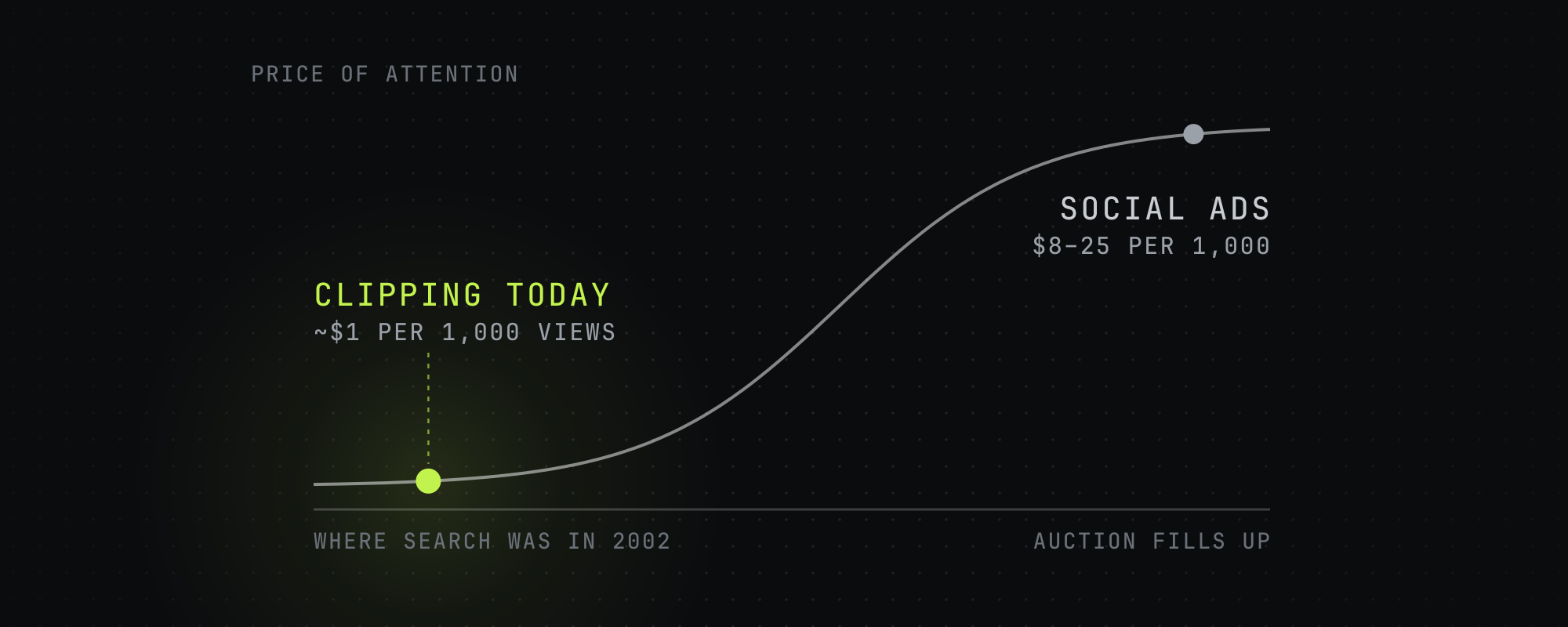
Clipping Is Where Paid Search Was in 2002
Clipping sells the same attention as a Meta or TikTok ad for roughly a tenth of the price, for the same reason AdWords clicks were cheap in 2002: the auction has not filled up yet. Three forces will close it (platform enforcement, FTC disclosure, and competition), and creator ad spend heading for $44 billion in 2026 says the third is already underway.
In February 2002 Google switched AdWords to cost-per-click pricing. For the next several years you could buy commercial intent for pennies, not because clicks were worth less then, but because almost nobody was bidding. The auction had not filled up.
Marketers who noticed early built companies on that gap. Marketers who noticed in 2012 paid ten times more for the same click and called it table stakes.
The gap is open again somewhere else.
| Channel | Cost per 1,000 views | Source |
|---|---|---|
| Traditional social ads | $8 to $25 | Forbes, April 2026 |
| Open clipping marketplaces | $0.20 to $6, average near $1 | Whop campaign data |
| Stake's clipper army | $0.50 to $0.80 | Bloomberg, March 2026 |
| MrBeast's clipper network | $0.50 | Bloomberg, November 2025 |
| Agency network vs platform quote | $25,000 vs $100 to $1,000 per million views | Forbes, April 2026 |
Same attention, same platforms, same viewers, at a fraction of what the ad auction charges.
Forbes reports that traditional social media ads run $8 to $25 per thousand views depending on platform, while clipping campaigns deliver comparable reach at roughly $1 per thousand on open marketplaces. Anthony Fujiwara, whose agency counts Netflix and Amazon Prime as clients, told Forbes that a million views quoted at $25,000 on one platform costs somewhere between one hundred and one thousand dollars through his network.
That is not a permanent feature of the universe. It is an inefficiency, and inefficiencies close.
Production went to zero, so the scarce thing moved
Making a video used to be the hard part: a shoot, an editor, a week of turnaround, four figures minimum. Now a founder with a laptop produces fifty variants before lunch.
OpusClip alone reported in March 2025 that its users had generated more than 172 million clips in a single year, accumulating over 57 billion views, across a base of more than 10 million creators and brands including Univision, Billboard, iHeartMedia, Visa, and LinkedIn.
When supply of content explodes, the constraint stops being "can I make this" and becomes "will anyone watch it." Attention did not get more plentiful, the number of things competing for it went up by orders of magnitude.
So the price of distribution rises while the price of production collapses. Meta's CPMs reflect that and TikTok's reflect that. Clipping does not yet, because it is priced like production labour rather than like distribution.
Nobody is bidding against you yet
The reason the price is low is unsexy: not enough buyers have shown up.
Whop's Content Rewards is barely eighteen months old as a real product. By April 2026 Forbes reported it was paying out more than $40,000 a day across nearly a million videos a month. Tether then invested $200 million at a $1.6 billion valuation in February 2026, and Whop reported 18.4 million users, roughly $3 billion in annual participant earnings, and gross transaction volume growing about 25% month over month.
Compare eighteen months to two decades of every performance marketer on earth grinding the Meta and Google auctions toward efficiency.
The buyers are arriving fast. US creator ad spend hit $37 billion in 2025 per the IAB, up 26% from $29.5 billion in 2024 and nearly triple the $13.9 billion spent in 2021, which is roughly four times the 5.7% growth rate of the media industry overall. IAB projects $44 billion for 2026, and 48% of ad buyers now call creators a must-buy, ranking the channel just behind paid search and social.
Every one of those buyers bids the price up a little.
Clips route around the ad-skipping reflex
Cheap is only half of it. Clips also perform better than ads at the same impression count, for reasons that are psychological rather than economic.
People have been trained since childhood to detect and discard advertising. A viewer sees the sponsored tag, the polished production, the logo in frame, and the thumb moves before any message lands.
A clip does not trip that filter. It arrives from an ordinary account, cut in the same style as everything else in the feed, with no label and no logo. Digital Music News described the effect precisely: the clips look like they could have come from any random superfan, which makes them feel organic in the feed.
The counterpart is that the moment you make it look like your ad, the advantage evaporates. Digiday's reporting makes this explicit, noting that slapping a brand logo on a clip or staging a product moment will not ring true with audiences.
Two more effects stack on top.
Repetition reads as consensus. The mere-exposure effect is among the most replicated findings in social psychology: familiarity breeds preference. When the same idea arrives from forty unrelated-looking accounts over three weeks, a viewer does not experience forty impressions of one campaign. They experience a trend.
Conflict outperforms quality. Because clippers are paid on views and views come from engagement, selection pressure favours whatever provokes reaction. CCDH's Imran Ahmed described the mechanism in the Andrew Tate case: controversy, dominance, and vulgar wealth display caused users to stop scrolling, which the algorithm rewarded, and a single hashtag tied to Tate drew 11.3 billion views in twelve months. We covered that campaign in full in how Andrew Tate became the most googled man on earth.
Digiday's May 2026 coverage records the critique from inside the industry. Critics argue clipping rewards the most extreme, boundary-pushing behaviour, nudging streamers to act out in hopes of going viral, and buyers who ignore that end up with reach they did not want attached to a brand they did.
The winners look nothing like the average
Clip performance follows a power law, which changes how a campaign should be designed. Most clips do a few hundred views, a handful do a few hundred thousand, and nobody can identify which is which before posting, including the person who made it.
The response is to stop picking and start funding attempts. One Stake campaign for Adin Ross produced 430 million views from 11,000 videos posted by 520 clippers, and that total did not come from consistent performance. It came from a distribution where the failures were nearly free. The full anatomy of that campaign is worth reading before you design your own.
The live-versus-clip split makes the same point. Streamer Timothy "TimTheTatMan" Betar told Digiday that short-form content now matters more than the livestream itself, and that he finds this hard to accept. He is describing where the funnel actually sits: the long-form content is the thing being made, the clip is the thing being seen.
Treating clipping as a promotional afterthought rather than the primary discovery channel is a budgeting error.
AI made clips free and made judgment expensive
OpusClip raised $20 million led by SoftBank's Vision Fund 2 in March 2025 at a $215 million valuation, and Munch, Vizard, Klap, and Descript compete in the same category. We compare them in the best AI video clipping tools in 2026.
The obvious read is that AI eliminates the clipper. The market says otherwise, because the tools solved the wrong half of the job.
Cutting, captioning, reframing, and exporting are done. Choosing which two seconds of a two-hour recording will stop a thumb is not. Every marketplace still pays per view rather than per clip, which is the market pricing judgment rather than labour, and if editing were the scarce input, campaigns would pay per delivered clip and be done with it.
The practical consequence: use AI to generate raw supply, because paying a human to move a crop box is waste, and use human judgment to decide what goes out. Volume comes from the software, hit rate comes from the person, and how to find viral moments is where that judgment gets specific. For a fuller breakdown of how per-view campaigns are structured, see our guide to content rewards.
Three things will close the window
Platform enforcement is already tightening. YouTube renamed its "repetitious content" policy to "inauthentic content" effective July 15, 2025, explicitly targeting mass-produced and templated uploads. Worth reading carefully: YouTube states there is no change to its reused content policy, which covers commentary, clips, compilations, and reaction videos. The crackdown is aimed at zero-effort templating, not at clipping with added value, and that distinction sets the quality floor going forward.
Regulation has an obvious first target. Almost no clips carry FTC disclosure. Jesse Saivar of Greenberg Glusker told Digiday that the agency lacks the bandwidth to pursue individual micro-posters, but flagged marketplaces as an efficient enforcement target. Forbes reported the first consequences have landed elsewhere: X suspended Stake-linked accounts, and the UK Gambling Commission brought enforcement action. One FTC action against a major marketplace would force disclosure across the channel, and disclosed clips lose the organic feel that makes them outperform.
Competition bids the price up. The most certain of the three, because it requires nobody to do anything except keep noticing. When marketplace CPMs approach the low end of the $8 to $25 range Forbes cites for conventional social ads, the arbitrage argument stops working.
Watch all three. When two of them land, the channel becomes a normal marketing expense rather than an edge.
What to do while it is still cheap
The channel is genuinely underpriced and genuinely unproven on conversion, both at once, and that should shape how you enter.
- Start with a capped marketplace campaign and treat the first one as a measurement experiment rather than a reach buy. Instrument it before you spend: unique promo codes, dedicated landing pages, UTM-tagged links. The IAB found measurement to be the industry's leading complaint, with advertisers explicitly asking for better attribution to link creator activity to business outcomes. If your vendor can only report views, you have bought unmeasured awareness and should budget it as such.
- Model economics on realised rates rather than headline rates, since budget caps, per-clip ceilings, and rejections all reduce delivery below the advertised CPM.
- Write disclosure into your campaign rules, especially in regulated verticals. It costs a little performance and removes the risk that scales with your success.
- Supply your own footage. It settles the copyright question before a clip exists, and it avoids the publicity-rights problem lawyers flagged to Digiday for brands clipping third-party content commercially.
The clicks stayed cheap for about five years after 2002, and nobody rang a bell when it ended. The marketers who did well spent aggressively while the number was low and stopped calling it a strategy once everyone else found it.
Frequently asked questions
What is the average CPM for a clipping campaign?
Open marketplace campaigns average near $1 per thousand views, ranging from roughly $0.20 to $6 depending on vertical and campaign. Realised rates come in lower than advertised rates because of budget caps, per-clip payout ceilings, and rejected submissions.
How does clipping compare to Meta and TikTok ads?
Forbes reports traditional social ads at $8 to $25 per thousand views. Clipping delivers comparable reach for a fraction of that, though without the targeting, attribution, and brand safety controls ad platforms provide.
Will AI clipping tools replace human clippers?
Not on the part that matters. AI has solved cutting, captioning, and reframing, collapsing per-clip production cost. Choosing which moment performs remains human judgment, and the fact that every marketplace still pays per view rather than per clip is the market pricing that judgment directly.
Why do clips outperform ads at the same impression count?
Viewers have a trained reflex to skip content that reads as advertising. Clips arrive from ordinary accounts in native format without sponsorship framing, so they do not trigger it. Industry reporting is consistent that the advantage disappears the moment a clip is made to look like a branded ad.
Did YouTube's 2025 policy update ban clipping?
No. YouTube renamed its repetitious content policy to inauthentic content effective July 15, 2025, targeting templated and mass-produced uploads. Its published guidance states there is no change to the reused content policy covering clips, compilations, commentary, and reaction videos.
How long will clipping stay cheap?
Three forces will compress the advantage: platform enforcement against low-effort mass posting, FTC disclosure enforcement (with marketplaces the likely target), and competition as more buyers enter. Creator ad spend is projected to reach $44 billion in 2026, which suggests the auction is filling.
Sources
Every figure above traces to one of these. Where a source sells the thing it measured, we say so.
- 01The 'Creator Of Clipping' Who Powers Crypto Gambling's Viral Machine · Boaz Sobrado, Forbes, April 2026
- 02Inside The 'Clipping Farms' Driving Fintech's Marketing Boom · Boaz Sobrado, Forbes, February 2026
- 03Paid armies of 'clippers' boost internet stars like MrBeast · Cecilia D'Anastasio, Bloomberg, November 2025
- 042025 Creator Economy Ad Spend & Strategy Report · IAB, November 2025
- 05Creator ad spend to reach $37B as marketers turn to AI for scale · Marketing Dive, November 2025
- 06YouTube channel monetization policies · YouTube HelpPrimary source for the July 2025 inauthentic-content rename.
- 07WTF is clipping? · Digiday, May 2025
- 08The case for and against clipping · Digiday, May 2026
- 09SoftBank Is Betting On The Future Of AI Content Creation With OpusClip · Forbes, March 2025
- 10OpusClip raises a new round of funding from SoftBank Vision Fund · OpusClip, March 2025Company source reporting its own usage figures.
- 11Tether invests $200 million in digital marketplace Whop · CoinDesk, February 2026
- 12Social media companies are to blame for Andrew Tate · Imran Ahmed, Context, January 2023
Keep reading
Stake Built a $4.7 Billion Business on Clips
One Stake campaign produced 430 million views from 11,000 videos posted by 520 clippers. The full anatomy of a paid clipping campaign, rates and risks included.
Clipping: How Andrew Tate Became the Most Googled Man on Earth
In 2022 Andrew Tate out-searched Trump, Kardashian and COVID-19 without buying an ad. The mechanism was an army of paid clippers. Here is how it worked.
Content Rewards: The Easiest Way to Start Making Money as a Clipper in 2026
Content rewards pay clippers a fixed rate per 1,000 views — no audience or upfront cost. How the model works, what you can really earn, and how to start.
The Clipper Economy: How $1.6B in Creator Payouts Got Built
Inside the clipper economy: marketplaces, agencies, CPMs, and the business model that turned video clipping into a multi-billion-dollar category.