Clipping: How Andrew Tate Became the Most Googled Man on Earth
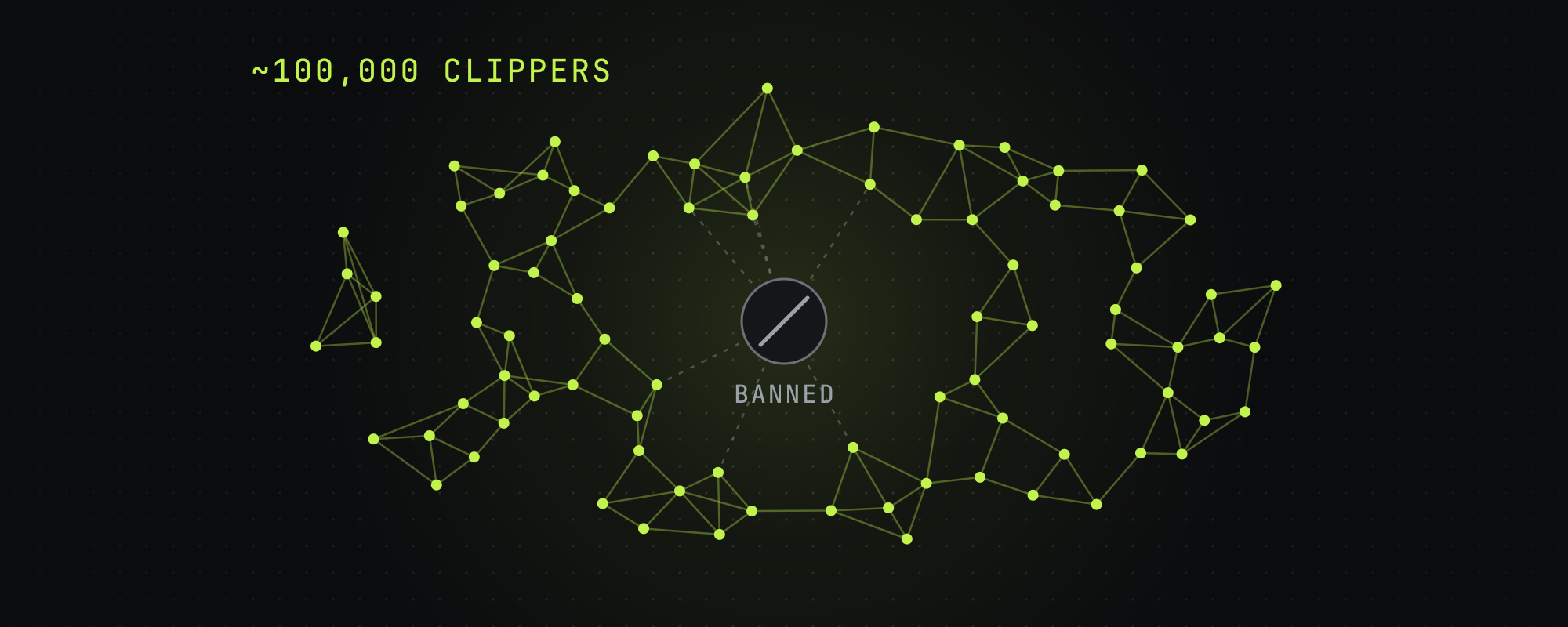
Tate's reach came from an affiliate program that paid roughly 100,000 Hustlers University members a commission to cut his podcast appearances into short clips and post them everywhere. Because the distribution never lived on his own accounts, the bans that landed across TikTok, Meta and YouTube in August 2022 did not stop it, and the same structure now sells Netflix shows and record labels.
Between July 17 and September 4, 2022, Andrew Tate received more Google searches than Donald Trump, Kim Kardashian, Kylie Jenner, and COVID-19. That finding comes from the Media Manipulation Casebook, a research project run out of Harvard's Shorenstein Center, which also documented his Instagram following growing from under 1 million to 4.6 million between May and August of that year.
Imran Ahmed, CEO of the Center for Countering Digital Hate, wrote in early 2023 that videos posted under a single hashtag associated with Tate had been viewed 11.3 billion times over the preceding 12 months, with more than 74% of those views coming from users under 24.
He did not buy a single ad.
What he built instead was a distribution machine made of people. Roughly 100,000 subscribers, each paid a commission, each posting clips of him across TikTok, Instagram Reels, and YouTube Shorts. That machine produced more reach in eight weeks than most global brands buy in a year, and it cost him nothing until it worked.
This article is about the mechanics, not the man. Tate was arrested in Romania in December 2022 on human trafficking and organised crime allegations, which he denies, and prosecutors filed a second indictment in 2024. None of that changes what happened to the distribution model he proved out, which got copied. Anthony Fujiwara, whose agency now counts Netflix and Amazon Prime as clients, told Bloomberg he studied Tate's virality strategies during the pandemic before building his business on them.
The affiliate program paid people to post, not to sell
Hustlers University launched in 2021 as a Discord community charging roughly $49.99 a month. It promised to teach ecommerce, copywriting, crypto, and dropshipping. Most of that content was mediocre and widely mocked.
The affiliate program was the actual product.
Members earned a commission for every new subscriber they recruited. An Observer investigation, summarised by CCDH, found that Tate used members of the academy to repost his clips in exchange for commission, and that his content was deliberately filled with hate and controversy to maximise engagement. Reported commission rates vary by source and period, from a 50% cut of the first month (roughly $25) down to 10% shortly before the program was cancelled.
The exact rate matters less than the incentive it created. If you were a 17-year-old who had paid $49.99 and wanted your money back, you had two options: learn dropshipping, which is hard and slow, or post a clip with your affiliate link, which is easy and takes four minutes.
Everybody chose the clip.
At its peak the program had well over 100,000 paying members, and each one had a financial reason to make Andrew Tate famous. No agency, no media buy, no creative approval process, just a hundred thousand independent distributors optimising the same objective function in parallel.
The clips were selected for conflict, because conflict is what travels
The instruction set given to affiliates was specific. Take Tate's podcast and interview appearances, cut the most polarising 30 seconds you can find, post it everywhere.
That selection criterion is the whole engineering feat. Affiliates were not told to post his best arguments or his most useful advice, they were told to find the moments that would make a viewer either defend him or attack him in the comments, because both behaviours feed the same algorithm. A furious comment and an admiring comment are identical inputs to a recommendation system.
CCDH ran experiments in August 2022 testing what TikTok recommended to accounts registered as 13-year-olds and found Tate content being pushed to teen boys within minutes of opening a new account. Ahmed's assessment was that the combination of controversy, dominance, and wealth display made users stop scrolling, which is the behaviour the algorithm rewards.
Academic analysis reached the same conclusion. Writing in The Conversation, researchers argued that nothing in Tate's actual rhetoric was new or original, and that the only genuinely innovative thing about him was his ability to game platform algorithms.
Tate did not out-create anyone. His clip supply was cut from footage that already existed, mostly interviews he gave for free on other people's podcasts. He out-distributed them.
Deplatforming failed because there was no platform to deplatform
In August 2022 TikTok, Facebook, Instagram, and YouTube all banned him inside the same month.
The clips kept running. CCDH's November 2022 analysis identified more than 100 accounts frequently promoting Tate content on TikTok, with a combined 250 million video views and 5.7 million followers. That was after the bans, not before.
The pattern held for years. CCDH's June 2025 report Banned But Not Gone examined the 100 most-viewed YouTube videos featuring Tate promoting misogyny over the preceding year, totalling nearly 54 million views. Of those 100 videos, 65 were made and posted by fan accounts rather than by Tate, and all 100 were viewable by 13-year-olds in the UK and US. CCDH also estimated YouTube earned up to £3.4 million in ad revenue from Tate-focused channels.
Deplatforming targets accounts, and a clip army has no account. When distribution lives across ten thousand faceless profiles that the subject does not own, does not pay for, and cannot be traced to, banning a personal handle removes one node from a network built to route around missing nodes.
Compare this to a brand spending $2 million a year on Meta ads. One policy violation, one account suspension, and the acquisition channel goes dark until an appeal clears. The single-account model has a single point of failure and the distributed model does not, which is the most transferable thing in the whole case.
Four years later, the same playbook sells Netflix shows
The model did not stay in the manosphere. It got professionalised, and the organisations buying it now are the least edgy on earth.
Anthony Fujiwara, 23, runs an agency called Clipping. Bloomberg reported in October 2025 that it had generated roughly $7.7 million in sales with around 23,300 contract editors, much of it paid in crypto. Netflix, Amazon Prime, and Capitol Music Group are clients, and United Talent Agency works with the company to funnel short-form audiences toward clients' YouTube, Spotify, and Twitch channels. Dante Smith, SVP and head of Motown Digital at Capitol Music Group, told Bloomberg that clipping promotes artists "through an organic UGC format", and confirmed campaigns for Ice Spice and Offset.
| Buyer | Reported scale | Reported terms |
|---|---|---|
| MrBeast | More than 1,000 clippers | $50 per 100,000 views |
| Stake (Adin Ross campaign) | 430M views, 11,000 videos, 520 clippers | $500 per million views, raised to $800 |
| Clipping (agency) | ~23,300 contract editors, ~$7.7M in sales | Retainers reported above $10,000 a month |
| Capitol Music Group | Campaigns for Ice Spice and Offset | Not disclosed |
| Whop Content Rewards | ~1M videos a month | More than $40,000 paid out a day |
Figures as reported by Bloomberg (November 2025) and Forbes (April 2026).
Whop's Content Rewards marketplace was paying out more than $40,000 a day across nearly a million videos a month by April 2026, according to Forbes, and Tether invested $200 million into Whop at a $1.6 billion valuation in February 2026. We break the marketplace layer down in content rewards, explained and the wider market in the clipper economy.
The mechanism never changed. Pay people per thousand views, let them find the moments, let volume do the selection.
What actually transferred from the Tate case
Strip out the personality and the controversy and four operating principles survive.
Pay on delivery, not on promise. Tate's affiliates got nothing until a signup landed, and modern campaigns pay per verified thousand views. In both versions the buyer carries no downside risk on a clip that flops, which is a different risk profile than a $10,000 influencer post that might do 4,000 views.
Let volume do the selection. Clip performance follows a power law, so most clips do a few hundred views and one does eleven million. Nobody can predict which is which, which is why you fund a thousand attempts instead of trying to pick. Tate ran this without knowing the term for it.
Own the source, not the accounts. Tate supplied the footage and thousands of independent accounts supplied the distribution. That split is why enforcement could not kill it, and it is why modern campaigns pre-clear rights by handing clippers the source files directly.
The clip is the funnel entrance, not the byproduct. Nobody browses for a two-hour podcast, so the clip is the only thing a stranger encounters. Streamer Timothy "TimTheTatMan" Betar told Digiday he finds it hard to accept that short-form now matters more than the livestream itself, which is a fair description of where the funnel actually sits.
The window is open and the price is still low
Forbes reports that traditional social ads run $8 to $25 per thousand views depending on platform, while clipping campaigns deliver comparable reach for a fraction of that. Fujiwara told Forbes he had seen platforms charge $25,000 for a million views where his network delivers the same for somewhere between one hundred and one thousand dollars.
That gap is a market inefficiency, and market inefficiencies close. US creator ad spend hit $37 billion in 2025 per the IAB's Creator Economy Ad Spend and Strategy Report, up 26% year over year against 5.7% growth for the media industry overall, with $44 billion projected for 2026. Nearly half of ad buyers now rank creators a must-buy channel. We put a timeline on how long that lasts in clipping is where paid search was in 2002.
Andrew Tate proved the mechanism worked when almost nobody was using it, and the people who copied him first got the cheapest attention on the internet for three years. The open question in 2026 is not whether clipping works, because eleven billion views settled that. It is how much longer it stays this cheap.
Frequently asked questions
What is clipping in marketing?
Clipping is the practice of cutting long-form video (podcasts, livestreams, interviews, films) into short vertical clips and distributing them across TikTok, Instagram Reels, and YouTube Shorts at volume. In paid campaigns, a brand supplies the source footage and pays independent editors a rate per thousand verified views.
How did Andrew Tate's affiliate program work?
Hustlers University charged roughly $49.99 a month and paid members a commission for recruiting new subscribers. An Observer investigation found affiliates were used to repost Tate clips in exchange for that commission, which turned the subscriber base into a distributed marketing force of over 100,000 people.
Why didn't deplatforming stop Andrew Tate?
His distribution did not depend on his own accounts. CCDH found over 100 Tate-promoting TikTok accounts with 250 million combined views in November 2022, after the bans. Its June 2025 follow-up found 65 of the 100 most-viewed Tate misogyny videos on YouTube were posted by fan accounts.
Is clipping still effective in 2026?
Traditional social ads run $8 to $25 per thousand views while clipping delivers comparable reach far cheaper, which has attracted Netflix, Amazon Prime, Capitol Music Group, and Polymarket as buyers. Platform enforcement against low-effort reposting is tightening, which raises the quality bar rather than closing the channel.
Is paying people to clip your content legal?
Yes, when the content owner supplies the source footage, which pre-clears the copyright question. The compliance risk sits in disclosure: FTC guidelines require paid endorsements to be labelled, and brands remain liable for undisclosed paid posts regardless of who published them.
Sources
Every figure above traces to one of these. Where a source sells the thing it measured, we say so.
- 01Andrew Tate and the Limits and Power of De-Platforming · Media Manipulation Casebook, January 2023
- 02Who is Andrew Tate? · Center for Countering Digital Hate
- 03Banned But Not Gone · Center for Countering Digital Hate, June 2025
- 04Social media companies are to blame for Andrew Tate · Imran Ahmed, Context (Thomson Reuters Foundation), January 2023
- 05Social media misogyny: the new way Andrew Tate brought us the same old hate · The Conversation
- 06Paid armies of 'clippers' boost internet stars like MrBeast · Cecilia D'Anastasio, Bloomberg, November 2025
- 07The 'Creator Of Clipping' Who Powers Crypto Gambling's Viral Machine · Boaz Sobrado, Forbes, April 2026
- 08The case for and against clipping · Digiday, May 2026
- 09Tether invests $200 million in digital marketplace Whop · CoinDesk, February 2026
- 102025 Creator Economy Ad Spend & Strategy Report · IAB, November 2025
Keep reading
Stake Built a $4.7 Billion Business on Clips
One Stake campaign produced 430 million views from 11,000 videos posted by 520 clippers. The full anatomy of a paid clipping campaign, rates and risks included.
Clipping Is Where Paid Search Was in 2002
Traditional social ads run $8 to $25 per thousand views. Clipping delivers comparable reach for around $1. The sourced math on how long that gap survives.
The Clipper Economy: How $1.6B in Creator Payouts Got Built
Inside the clipper economy: marketplaces, agencies, CPMs, and the business model that turned video clipping into a multi-billion-dollar category.
What Is Content Clipping? The 2026 Guide to Getting Paid to Clip
Content clipping is cutting long-form video into short clips that get distributed at scale — and increasingly, paid per view. What it is, how it pays, how to start.