Stake Built a $4.7 Billion Business on Clips
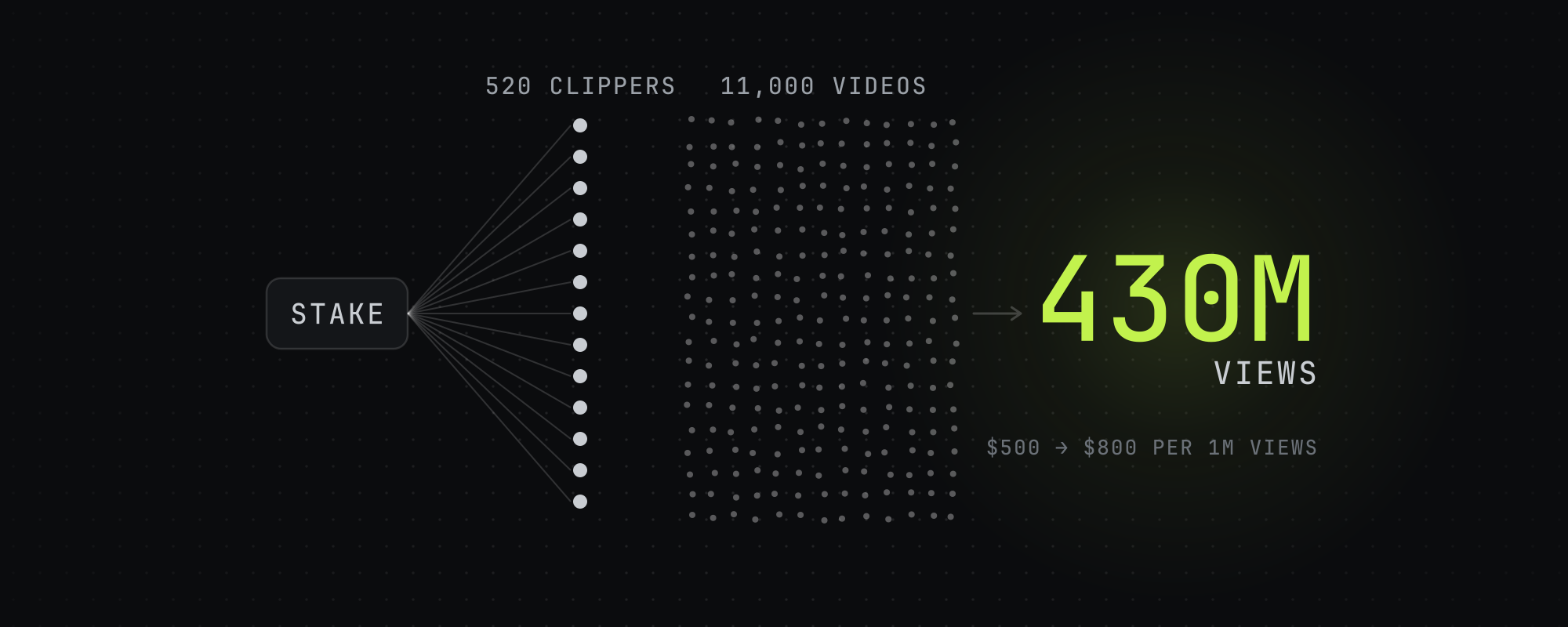
Locked out of Google and Meta ads, Stake bought the feed instead: one Adin Ross campaign generated 430 million views from 11,000 videos posted by 520 clippers, paid at $500 per million views and later $800. The campaign is the clearest public blueprint for how paid clipping runs at scale, including the four places it breaks.
Stake cannot run a Google ad. It cannot run a Meta ad. Most conventional advertising channels are closed to online casinos by policy, by regulation, or by both.
So it bought the feed instead.
One Stake campaign built around streamer Adin Ross generated 430 million views from 11,000 individual videos posted by 520 separate clippers, according to Bloomberg. Not 520 sponsored posts, but eleven thousand pieces of content, each cut from footage Stake and Ross already owned, each posted from an ordinary-looking account.
Bloomberg's March 2026 investigation into the casino described the mechanism plainly: Stake pays a thousands-strong army of clippers to scatter videos of its stars celebrating jackpots, drawing in anyone intrigued by the winnings or the swagger. Clippers received $500 per million views until December, when Stake raised the bounty to $800, according to a person with knowledge of the arrangement.
That campaign is the clearest available blueprint for how paid clipping works at scale. Everything that makes it efficient is visible in it, and so is everything that makes it risky.
Getting banned from ad platforms forced the innovation
Gambling and crypto adopted clipping before anyone else, and constraint is the reason. When Google and Meta will not take your money, you find attention somewhere they do not control.
That pushed casino operators toward Kick and Twitch streamers whose audiences overlapped with theirs, with the clipping layer sitting underneath the sponsorship. A streamer takes a deal and streams for four hours, and four hours of footage is worthless to a stranger who does not follow him. Cut it into 400 clips and post them across TikTok, Reels, and Shorts, and the four hours reaches people who have never heard of the streamer or the casino.
Bloomberg captured the instruction being given directly. In a scene from its investigation, a Stake executive advised Adin Ross to get the clips viral and to make sure some of them showed the Stake logo large and clear.
Categories with no ad access built the playbook. Categories with full ad access are now copying it.
What a campaign costs and what clippers actually earn
| Buyer or platform | Published rate | Per 1,000 views |
|---|---|---|
| Stake | $500 per million views, $800 from December | $0.50 to $0.80 |
| MrBeast | $50 per 100,000 views | $0.50 |
| Whop Content Rewards | Marketplace average near $1 | $0.20 to $6 |
| Roobet (Whop campaign) | $250,000 budget | $1.50 |
| Clipping (agency) | Retainers above $10,000 a month for larger clients | Not published |
Rates as reported by Bloomberg (November 2025 and March 2026), Forbes (April 2026), and Digital Music News (October 2025).
On the agency side, Bloomberg reported Fujiwara's Clipping had generated around $7.7 million in sales with roughly 23,300 contract editors, with clients allocating in some cases more than $10,000 a month. Fujiwara told Forbes that where one platform quoted $25,000 for a million views, his network delivers the same for somewhere between one hundred and one thousand dollars.
On marketplaces, Whop's Content Rewards campaigns run roughly $0.20 to $6 per thousand views with a marketplace average near $1. Forbes reported in April 2026 that Whop was paying out more than $40,000 a day across nearly a million videos a month. Emily Lai, CMO at growth marketing firm Hype Partners, noted that some crypto campaigns run as low as $0.20 per thousand. Our niche-by-niche breakdown has the fuller picture.
Realised rates come in below advertised rates. Budget caps, per-clip payout ceilings, minimum payout thresholds, and rejected submissions all take a bite, and a clip that beats the per-video cap delivers free views to the brand beyond that ceiling. Model your economics on what actually pays out, not on the headline CPM.
For the top of the labour market the money is real. The median clipper earns very little, which is what any power-law market produces.
The campaign runs on four moving parts
Source footage. The buyer supplies raw video: stream VODs, podcast episodes, ad creative, film footage, or a music track. Much of Stake's visibility came from clippers downloading short clips from a shared Google Drive and posting them across Instagram, TikTok, and YouTube Shorts, per Forbes. Supplying the footage is what makes the campaign clean legally, because the copyright question is settled before a clip exists.
A brief and a rate. The buyer posts the campaign: here is the footage, here is what to emphasise, here is the payout per thousand views, here is the budget cap. Once the cap is hit, the campaign closes.
Distributed posting. Clippers cut, caption, and post from their own accounts. There is no media plan and no placement, just five hundred people independently deciding what to make and where to put it. Forbes described the structure behind Stake's machine as having no employment contracts at all, just a Discord server, a merit ladder, and relentless volume.
Verification and payout. Platforms pull view counts through official APIs rather than accepting screenshots, and run duplicate and bot detection. Clipping runs human review on submissions, and every Whop submission is reviewed by the brand running the campaign. Content rewards, explained walks through the marketplace mechanics end to end.
The system is a market for one thing: judgment about which two seconds of footage will stop a thumb. Editing is commoditised, choosing the moment is not, and the per-view rate is what pays for it.
11,000 videos is the strategy, not an accident
Clip performance follows a power law. Most clips do a few hundred views, a small number do a few hundred thousand, and one in ten thousand does eight figures.
Nobody can predict which is which before posting, not the buyer, not the agency, not the clipper who made it. So the rational campaign design stops trying to pick winners and funds attempts instead.
Stake's 430 million views did not come from 11,000 clips each doing 39,000 views. They came from a distribution where most clips did nearly nothing and a few carried the result, and because the buyer paid the same rate for both, the failures cost almost nothing and the winners were extremely cheap.
This is the structural advantage over a single sponsored post. A $5,000 influencer placement is one bet at one price with a fixed downside, while the same $5,000 spread across a clipping campaign is hundreds of independent attempts on the same footage. If the sponsored post underperforms, the money is gone. If most of the clips underperform, the campaign still delivers, because the handful that hit are what was being paid for.
Aida Andersson, head of commercial at UGC games media company Chartis, told Digiday that discovery is now algorithm-driven and passive, which changes how campaigns have to show up in the first place. She works with Hollywood studios trying to reach younger audiences.
Where the model breaks, honestly
Four weaknesses. Pretending they do not exist is how buyers waste money.
View counts are not conversions. Clipping buys attention, and whether that attention converts depends on the offer. The IAB's 2025 report found measurement is the industry's top stated problem, with advertisers asking for better attribution and consistent reporting to link creator activity to business outcomes. Instrument your campaign with unique promo codes or dedicated landing pages before you spend.
Fraud is a live cost. ClipAffiliates, a competing marketplace, reports that roughly one in three views ever submitted to it came from accounts later banned for faking views, all caught by verification before payout. Treat that as a vendor-sourced figure with an incentive behind it, but the direction is corroborated by brands reporting bot rings calibrated to per-clip payout caps.
Brand safety is thin. Your footage goes out through unvetted accounts that also post other things, and you control the source and the brief, not the account, the caption, or the comments. Digiday noted that a logo slapped onto a clip will not ring true with audiences, which is the tension at the centre of the channel: the more it looks like your ad, the worse it performs.
Disclosure is routinely ignored. Almost no clips carry paid-promotion labels. Jesse Saivar, Chair of Greenberg Glusker's IP and Digital Media groups, told Digiday that the FTC realistically will not pursue an individual micro-influencer over a 30-second video because it lacks the bandwidth. He flagged the marketplaces themselves as the more attractive target, noting that a platform like Whop presents a way to address a lot of rule-breaking at once. Whop's terms require clippers to follow FTC disclosure rules; enforcement is another matter.
Consequences have started landing. Forbes reported that X suspended Stake-linked accounts and the UK Gambling Commission brought enforcement action, the first significant penalties for clip farming. Nikita Bier, X's head of product, publicly flagged the practice on the platform, describing coordinated undisclosed paid posts as clipping agencies taking over the timeline for a day.
Why the same structure now sells albums and AI apps
Stake had no alternative. The interesting development is that categories with full ad access are choosing clipping anyway.
Capitol Music Group ran campaigns for Ice Spice and Offset, with Motown Digital head Dante Smith describing it to Bloomberg as promoting artists through an organic UGC format. Netflix, Amazon Prime, and United Talent Agency are all in, and Whop campaign budgets include Roobet at $1.50 per thousand against a $250,000 budget.
Forbes's February 2026 piece documented the same structure moving into fintech, where investment apps, crypto firms, and AI companies are the most willing to accept the disclosure risk.
None of these are locked out of Google Ads. They chose a channel at a fraction of the CPM, running content that does not read as advertising to a viewer trained since childhood to skip anything that does, and that price gap has a shelf life.
Stake proved the model under maximum constraint. Everyone else is now running it by choice, which is the stronger signal.
Frequently asked questions
How much do clippers get paid per view?
Published rates range from about $0.20 to $6 per thousand views, with marketplace averages near $1. Stake paid $500 per million views, later raised to $800. MrBeast's team pays $50 per 100,000 views. Agencies charge clients from a few thousand dollars a month upward.
How do brands verify clip views are real?
Reputable marketplaces pull view counts through official TikTok, YouTube, and Instagram APIs rather than accepting screenshots, and run duplicate and bot detection. Agencies add human review of submissions. Fraud remains a genuine cost, with competing platforms reporting significant volumes of submitted views traced to accounts later banned.
Is clipping cheaper than running ads?
Substantially, on cost per thousand views. Forbes reports traditional social ads at $8 to $25 per thousand views against clipping campaigns delivering comparable reach for a fraction of that. The tradeoff is that ad platforms provide targeting, attribution, and brand safety controls clipping campaigns do not.
Who owns the copyright on clips?
In a properly run campaign the buyer supplies the source footage, which pre-clears rights before any clip is made. Unauthorised clipping of someone else's content is riskier, and lawyers quoted by Digiday note that brands clipping third-party content for commercial purposes also run into publicity-rights problems.
What size budget does a clipping campaign need?
Marketplace campaigns can start in the low thousands. Roobet ran a $250,000 campaign at $1.50 per thousand views. Agency retainers reported by Bloomberg run to more than $10,000 a month for larger clients.
Sources
Every figure above traces to one of these. Where a source sells the thing it measured, we say so.
- 01Drake, Adin Ross Have Unusual Win Rates at Crypto Casino Stake · Bloomberg, March 2026
- 02Paid armies of 'clippers' boost internet stars like MrBeast · Cecilia D'Anastasio, Bloomberg, November 2025
- 03The 'Creator Of Clipping' Who Powers Crypto Gambling's Viral Machine · Boaz Sobrado, Forbes, April 2026
- 04Inside The 'Clipping Farms' Driving Fintech's Marketing Boom · Boaz Sobrado, Forbes, February 2026
- 05WTF is clipping? · Digiday, May 2025
- 06The case for and against clipping · Digiday, May 2026
- 07The Rise of Contract Clippers in the Attention Economy · Digital Music News, October 2025
- 082025 Creator Economy Ad Spend & Strategy Report · IAB, November 2025
- 09ClipAffiliates vs Whop · ClipAffiliatesVendor source. It sells the verification it is reporting on, so treat the fraud statistics as directional.
Keep reading
Clipping Is Where Paid Search Was in 2002
Traditional social ads run $8 to $25 per thousand views. Clipping delivers comparable reach for around $1. The sourced math on how long that gap survives.
Clipping: How Andrew Tate Became the Most Googled Man on Earth
In 2022 Andrew Tate out-searched Trump, Kardashian and COVID-19 without buying an ad. The mechanism was an army of paid clippers. Here is how it worked.
Content Rewards: The Easiest Way to Start Making Money as a Clipper in 2026
Content rewards pay clippers a fixed rate per 1,000 views — no audience or upfront cost. How the model works, what you can really earn, and how to start.
CPM Rates for Clippers by Niche: Music, Gaming, Finance, Fitness
Actual CPM rates paid to clippers by niche in 2026: music ($0.10-$2), gaming ($0.40-$0.50), finance ($1-$5), fitness/coaching premium ($5-$50).