What Percentage of Short-Form Clips Actually Go Viral?
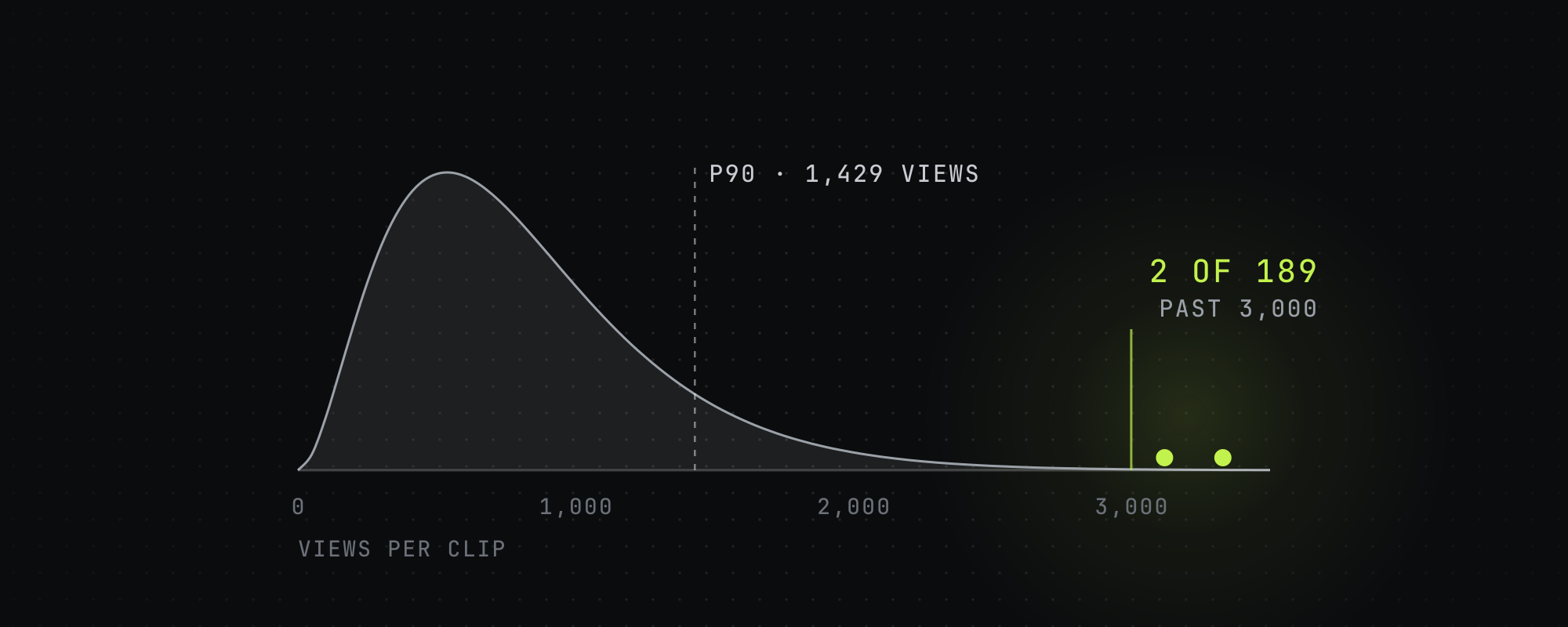
Across 189 published clips on our own network, the 90th percentile sits at 1,429 views and only two clips ever crossed 3,000, which is a tighter, more capped distribution than a '1 in 10 is a 2-3x outlier' framing suggests. The clearest lever we found is length combined with rewatchability: clips under 20 seconds that loop score more than double the clips under 20 seconds that don't. Most of what looks like bad luck (a suppressed topic, a duplicate post, a new channel's first week) turns out to have a specific, fixable cause.
In a recent talk about where social media is heading, Alex Hormozi tossed off a specific, testable number: "we just know that one out of ten shorts is going to be a two or three X outlier." He said it in passing, the way you'd state something everyone in the room already accepted.
We run our own network of short-form clip channels on the same AI pipeline behind Highstyle, so we pulled the real numbers and checked it. The short version: the real distribution is tighter than ten rolls of dice waiting on one lucky outlier, and what actually separates a clip that performs from one that doesn't turns out to be more mechanical than lucky.

The real distribution
Across 189 published clips on our network, totaling 172,192 views, the 90th percentile sits at 1,429 views. Only two clips, out of 189, ever crossed 3,000. Nearly half of everything lands in a narrow band between 900 and 1,500 views, and the average across the full set works out to just over 900 views a clip.
In 189 clips, exactly two ever broke 3,000 views. That's not the shape of a lottery with rare giant winners. It's a distribution with a hard ceiling, and most of the mass packed just underneath it.
That distinction matters, because "one in ten is a 2-3x outlier" describes a wide, long tailed pattern: most attempts do modest numbers and a rare few do multiples of that. What we actually see is closer to a capped distribution, a large cluster performing within a fairly narrow range of each other, with almost nothing escaping it in either direction.
Engagement doesn't explain the gap either
If the top clips were simply better content, you'd expect them to get liked, shared, or commented on at a higher rate, on top of being seen by more people. Across all 189 clips, the like rate sits at 0.55% of views, comments at 0.07%, shares at a flat 0.01%, twenty-five shares total across 172,192 views. The 19 clips that cleared 1,500 views carried a 0.58% like rate, essentially identical to everything else.
The clips that did better were simply reaching more people, at close to the same rate of approval as everything else, which points at distribution rather than quality as the thing doing the work. Retention tells a similar story: it correlates with views at r = 0.21, and moving from the worst retention quartile (40%) to the best (86%) lifts the median from 522 to 1,136 views. Real, but nowhere near enough to explain a 3,000-view clip on its own.
The one lever that actually moves the number
One combination stands well clear of everything else we measured: clips at 20 seconds or under that get watched more than once. A clip that short with an average view percentage over 100%, meaning the typical viewer watched it more than once, posted a median of 1,364 views, with 38% clearing 1,500 and none dying. A clip just as short without that rewatch effect was the worst bucket on the entire network: a median of 588 views, with roughly a third landing near zero.
A clip under 20 seconds that gets rewatched scores more than double the median of an equally short clip that doesn't. That's the clearest lever we've found, and it has nothing to do with the topic or the person on camera.
Short and rewatchable together is what moves the number. A clip that ends before the swipe reflex fires gets looped almost by accident, and platforms appear to read a loop as a much stronger engagement signal than a single complete watch, which is the part a raw view count never shows you.
How clips actually end up at zero
The bigger risk in this data is landing in the zero bucket for a reason that has nothing to do with the clip itself.
| What causes it | What we measured |
|---|---|
| A suppressed topic | About 40% of a month's uploads were burned on topics that get held back from distribution before anyone sees them, until a topic filter caught it |
| A duplicate moment | Two of four copies of the same moment, posted across different channels, sat at exactly zero views while the first copy drew 1,151 elsewhere two days earlier |
| A new channel's first week | One channel spent its first ten days at 2 to 97 views regardless of quality, then broke through and has cleared over 1,100 views on every clip since |
| A failed upload | A dropped connection mid-upload can leave a public video page with no video behind it, indistinguishable from a genuine flop until you check the file itself |
None of these four is a talent problem. Each one is avoidable once you know to look for it, which is a different message than "nine out of ten attempts just don't work out."
So was Hormozi's number right?
Directionally, yes. Most clips land in a narrow middle, and a small minority do meaningfully better than the rest. Where our numbers complicate the story is in what explains the gap. A "one in ten" framing suggests the winners are somewhat unpredictable, clips that happened to catch a wave. Ours points closer to the opposite: the clips that broke out mostly shared one identifiable trait, short and rewatchable, and most of what reads as bad luck from the view count alone (a suppressed topic, a duplicate post, a new channel's first week) has a specific, checkable cause once you look at retention data instead of views on their own.
What this means if you're clipping your own content
- Design for a second watch, the whole point of staying short. A clip that earns a rewatch is worth more than a longer clip that earns one careful watch and nothing else. Our own guide to clip length by platform goes deeper on where that ceiling tends to sit.
- Give a new channel or format a real runway before judging it. A near-zero first week can mean nothing about the content and everything about the account still being new.
- Never post the same moment twice, on any channel. The clips that die this way aren't unlucky, they're competing with an earlier copy of themselves.
- Check retention next to views before writing a clip off. A clip with strong retention and weak views was probably never shown to many people, which is a distribution problem, not a content problem, and the fix is different. How to find viral moments covers the selection side of that in more detail.
One honest caveat: this is our own network, on YouTube Shorts specifically, across a handful of niches, not a study of the whole platform. The exact numbers will move for a different niche or platform. The mechanism, a platform deciding who sees a clip before any audience gets to judge it, and short, rewatchable clips being what tips that decision in your favor, is the part we'd expect to hold up elsewhere.
Frequently asked questions
What percentage of short-form videos actually go viral?
In our own network of 189 published clips, only two ever crossed 3,000 views, and the 90th percentile sits at 1,429. That's a much tighter distribution than a rare-outlier model suggests: most clips land within a fairly narrow band, and very few escape it in either direction.
How many views is good for a short video?
On our network, just over 900 views was the average across 189 clips, with almost half landing between 900 and 1,500. What matters more than any single number is where a clip sits relative to your own channel's typical range, since that range varies enormously by niche and audience size.
Why do some clips get zero views?
In our data, near-zero clips usually trace back to one of four specific causes: a topic that gets held back from distribution, a duplicate of a moment already posted elsewhere, a channel still in its first week or two, or a failed upload that left a public page with no video behind it. Each has a specific fix, which is different from the content itself being bad.
Does clip length affect how well a video performs?
Length matters, but rewatchability matters more. Clips of 20 seconds or under that got watched more than once scored a median of 1,364 views with none dying, while equally short clips that didn't get rewatched scored a median of 588 with about a third landing near zero, more than double the gap on length alone.
Is Alex Hormozi's one in ten rule accurate?
Directionally, yes: a small minority of clips clearly outperform the rest. Our own numbers suggest the mechanism is more identifiable than "getting lucky," though. The top performers mostly share one measurable trait (short and rewatchable), and a large share of what looks like bad luck at the bottom has a specific, fixable cause.
Sources
Every figure above traces to one of these. Where a source sells the thing it measured, we say so.
- 01You Need to Prepare Before Social Media Changes Forever · Alex Hormozi, MoreMozi, September 2026Source of the '1 in 10 shorts is a 2-3x outlier' claim this article tests against our own published clip data.
Keep reading
Content Is a Business Function, Not a Marketing Channel
A typical seven-figure business publishes 365 pieces of content a year. Alex Hormozi's portfolio publishes 35,000. The gap is staffing, not talent, and it changes how content should be run.
Why Your Content Gets Views but No Customers
A video can perform well on views and still produce nothing for the business behind it. Alex Hormozi's four-part test explains why, and gives you a way to check your own content against it.
Why Your YouTube Shorts Get No Views (It's Usually Not Your Content)
We joined lifetime views with retention data for 84 published Shorts. The flops had 59% retention — they were never distributed. How the Shorts gate works and how to beat it.
Best Clip Length for TikTok, Reels, and Shorts in 2026
The algorithm-optimized clip lengths for TikTok, Instagram Reels, and YouTube Shorts in 2026 — and why completion rate, not duration, is what you're really optimizing.